

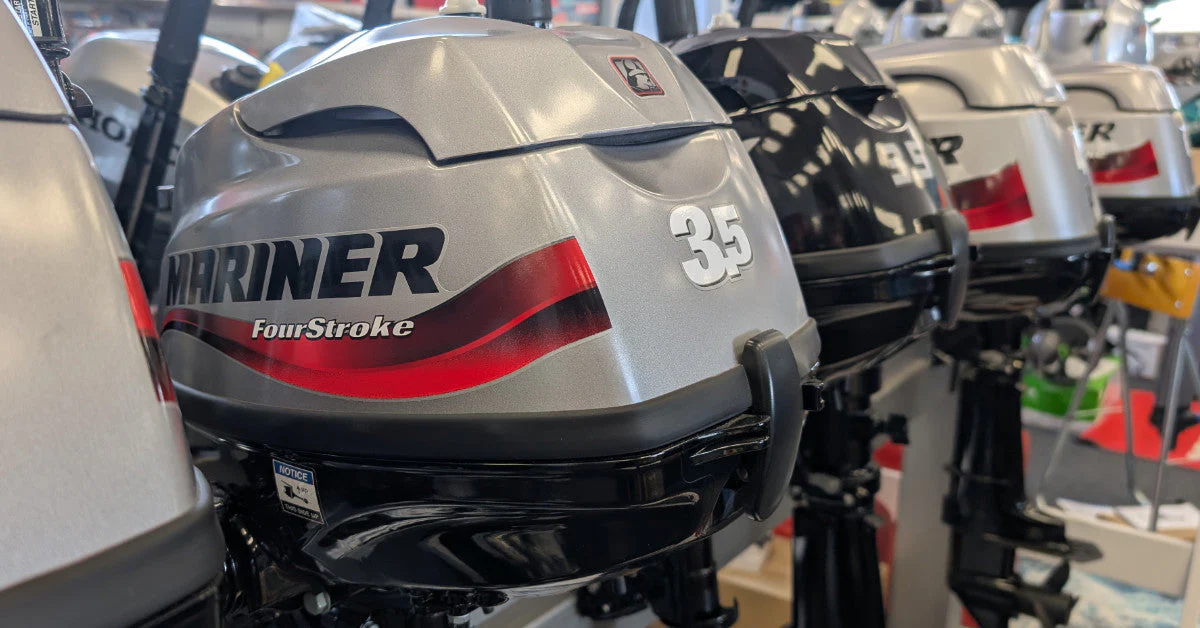
There’s nothing quite like the feeling of throttling up and watching the bow rise as your boat planes off. But at the heart of that experience is one critical piece of machinery: your outboard motor.
Whether you’re repowering an old bay boat, rigging a new center console, or buying your first fishing skiff, choosing the right outboard can feel overwhelming. With three major manufacturers dominating the market, varying horsepower needs, and the constant debate of new vs. used, how do you make the right call?
This guide covers everything you need to know about outboard motors—from selecting the right horsepower to performing maintenance that will keep it running for 5,000 hours.
What is an Outboard Motor?
An outboard motor is a self-contained propulsion system mounted on the transom of a boat. Unlike inboard engines, outboards combine the engine, gearcase, and propeller into a single unit that steers by pivoting.
Modern outboards have evolved dramatically from the smoky two-strokes of the 1980s. Today, they are quiet, fuel-injected, computer-controlled machines that offer reliability unheard of a generation ago.
Step 1: Choosing the Right Outboard Motor
Selecting an outboard isn’t just about horsepower—it’s about matching the engine to your hull, your usage, and your budget.
The Big Three Manufacturers
While there are smaller players, the outboard market is dominated by three brands. You can’t go wrong with any of them, but each has strengths.
| Brand | Reputation | Best For |
|---|---|---|
| Mercury Marine | High performance, extensive dealer network | Speed, bass boats, saltwater fishing |
| Yamaha | Unmatched reliability, strong resale value | Offshore fishing, bay boats, longevity |
| Suzuki | Fuel efficiency, value for money | Cruisers, budget-conscious buyers, tech features |
Pro Tip: Choose your dealer before you choose your brand. A great mechanic 10 minutes from the ramp is worth more than a slight price difference on the engine itself.
Two-Stroke vs. Four-Stroke
This is the most significant decision you’ll make.
Four-Stroke Outboards
-
Pros: Quieter, cleaner emissions, better fuel economy, no oil mixing, excellent low-end torque.
-
Cons: Heavier, more expensive to purchase, and more complex maintenance.
-
Verdict: The standard for 90% of boaters today.
Two-Stroke (Direct Injection)
-
Pros: Lighter weight, faster hole shot, simpler design.
-
Cons: Louder, burns oil, less fuel efficient, and being phased out by emissions regulations.
-
Verdict: Great for performance applications (bass boats, light skiffs) or as a budget used option.
How Much Horsepower Do You Really Need?
The boat’s capacity plate (usually located near the helm) lists the maximum horsepower. While you can max it out, you don’t always need to.
-
Rule of Thumb: You want to be within 70-85% of the max rated horsepower for optimal performance.
-
Underpowered: An underpowered boat struggles to plane, burns more fuel than it should, and is unsafe in rough seas.
-
Overpowered: Exceeding the max rating is illegal, voids insurance, and is dangerous.
Horsepower Guidelines:
-
Small skiffs / Jon boats: 15–40 HP
-
Bay boats / 18-20 ft: 115–150 HP
-
Center consoles / 22-25 ft: 200–300 HP
-
Offshore / 30 ft+: Twin 250–425 HP
Step 2: New vs. Used Outboard Motors
This is where you can save thousands—or lose your shirt.
Buying New
Pros:
-
Warranty: 3 to 6 years of factory warranty (Mercury offers up to 6 with promotion).
-
Reliability: Zero hours; you know the break-in was done correctly.
-
Technology: Latest fuel injection, digital controls, and integration with modern electronics.
Cons:
-
Cost: A new 250hp outboard can cost $25,000–$30,000 rigged.
-
Depreciation: Like a new car, it loses value the moment you mount it.
Buying Used
Pros:
-
Value: A well-maintained 5-year-old outboard can be half the price of new.
-
Parts Availability: Older models often have abundant aftermarket parts.
Cons:
-
Risk: You don’t know if it was flushed after saltwater use or if it overheated.
-
No Warranty: Unless it’s a transferable factory warranty.
How to Inspect a Used Outboard:
-
Check the Lower Unit Oil: It should be honey-colored. If it’s milky (water intrusion) or smells burnt, walk away.
-
Look for Corrosion: Check the midsection and steering components. Paint bubbling indicates hidden corrosion.
-
Cold Start: The engine should start easily when cold. If it requires starter fluid, the fuel system has issues.
-
Ask for Maintenance Records: A seller who kept a log of water pump and oil changes is a seller you can trust.
Step 3: Installation and Rigging
Mounting an outboard isn’t as simple as bolting it to the transom. Proper rigging affects performance, safety, and fuel efficiency.
Mounting Height
The engine’s anti-ventilation plate (the flat plate just above the propeller) should be even with the bottom of the boat’s hull.
-
Too Low: Creates drag, reduces top speed, and causes steering torque.
-
Too High: Causes propeller ventilation (cavitation) and poor hole shot.
Steering Systems
-
Hydraulic Steering (Seastar): The gold standard for boats over 150hp. Provides smooth, effortless control and eliminates torque steer.
-
Mechanical (Cable) Steering: Fine for smaller engines (under 115hp). It’s cheaper but requires more physical effort.
Electronic Integration
Modern outboards (especially Mercury and Yamaha) connect directly to your fish finder/chartplotter. This allows you to see fuel burn, engine hours, water pressure, and fault codes on a single screen. If you’re repowering, factor in the cost of a new digital gauge package or NMEA 2000 network.
Step 4: Outboard Motor Maintenance
An outboard motor is a harsh-environment machine. Saltwater, heat, and vibration are constant enemies. Follow these maintenance intervals to avoid being towed back to the ramp.
Every Trip
-
Flush with fresh water: Use flushing muffs or the built-in flush port. Run the engine for 5–10 minutes to remove salt and debris.
-
Rinse the exterior: Salt left on the cowling and midsection leads to corrosion.
Every 100 Hours (or Annually)
-
Change Lower Unit Oil: This is non-negotiable. Gear oil is cheaper than a lower unit rebuild ($2,000+).
-
Replace Water Pump Impeller: Rubber impellers harden over time. If the engine isn’t peeing a strong stream, replace it immediately.
-
Change Engine Oil & Filter (Four-Stroke): Use OEM filters. Cheap filters can fail and starve the engine of oil.
-
Inspect the Propeller: Check for dings and spun hubs. A damaged prop vibrates and damages the seals in the lower unit.
Every 300 Hours
-
Replace Timing Belt (If equipped): Suzuki and some other four-strokes have timing belts that must be replaced at specific intervals. Failure is catastrophic.
-
Replace Spark Plugs: Fouled plugs cause hard starting and poor fuel economy.
Winterization (For Northern Climates)
If you live where water freezes, you must winterize:
-
Run the engine on fresh water to flush salt.
-
Fog the cylinders with fogging oil.
-
Drain all water from the engine block (most modern outboards self-drain when tilted down, but check your manual).
-
Stabilize the fuel and fill the tank to prevent condensation.
Step 5: Common Outboard Motor Problems & Fixes
Even the best outboards have issues. Here’s how to diagnose common symptoms.
| Symptom | Likely Cause | Quick Fix |
|---|---|---|
| Engine won’t start | Dead battery, kill switch lanyard, old fuel | Check battery voltage; ensure lanyard is attached; prime primer bulb |
| Weak pee stream / overheating | Worn water pump impeller | Replace impeller immediately; do not run engine |
| Loss of power at high RPM | Clogged fuel filter, prop spun hub | Replace fuel/water separator; check prop hub |
| Hard starting when cold | Low battery, old fuel, stuck choke | Charge battery; run fuel stabilizer |
| Steering is stiff | Corroded steering cable or hydraulic seals | Lubricate steering tube; rebuild hydraulic system |
Where to Buy an Outboard Motor
1. Authorized Dealers
The safest route. You get factory warranty, professional rigging, and ongoing service support. Negotiate on rigging costs (gauges, props, labor) rather than just the engine price.
2. Online Retailers
Websites like Outboard Exchange or Boatzincs offer new engines shipped to your door.
-
Pros: Competitive pricing.
-
Cons: You are responsible for rigging; warranty service must be done at a local dealer, who may prioritize their own customers.
3. Private Party (Used)
Facebook Marketplace, The Hull Truth classifieds, Craigslist.
-
Pros: Best prices.
-
Cons: Highest risk. Always perform a water test (sea trial) before buying.
Final Verdict: Which Outboard Should You Buy?
If you are buying new and fish saltwater, Yamaha is the king of reliability, though Mercury offers stronger performance in the high-horsepower range.
If you are buying new and want the best value, Suzuki often comes in 10-15% cheaper than the competition with similar reliability and superior fuel economy.
If you are buying used on a budget, A well-maintained Mercury Optimax (two-stroke direct injection) offers excellent performance for half the price of a new four-stroke.
FAQ: Outboard Motor Edition
Q: How long do outboard motors last?
A: With proper maintenance, a modern four-stroke outboard can last 3,000–5,000 hours. For a recreational boater using 100 hours a year, that’s 30–50 years.
Q: Is it worth repowering an old boat?
A: If the hull is in excellent condition (no soft spots, transom rot), repowering is often cheaper than buying a new boat. A new outboard adds reliability and resale value.
Q: Can I install an outboard myself?
A: If you have a hoist, torque wrench, and mechanical skills, yes. However, the warranty may require professional installation. Also, connecting digital gauges and steering can be complex.
Q: What size outboard do I need for a 20-foot boat?
A: Most 20-foot fiberglass center consoles are rated for 150–200 HP. A 150 HP will get you on plane; a 200 HP will give you optimal performance and resale value.
Are you repowering this season? What outboard are you running on your boat? Drop your experience in the comments—we’d love to hear from you!
